Three Independent Standards That Actually Measure Roof Performance
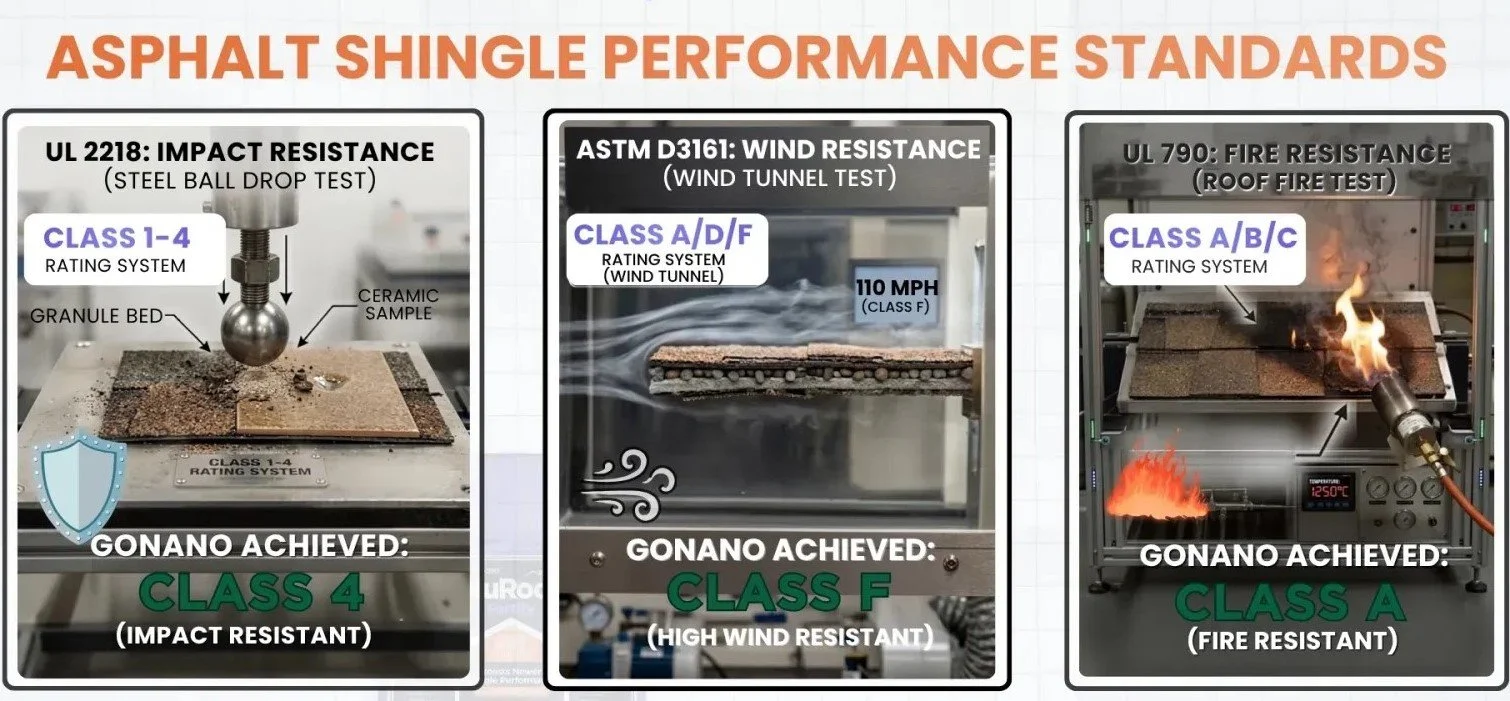
Three North American standards provide independent measurements of roof performance: UL 2218 for impact resistance (graded Class 1 through Class 4), ASTM D3161 for wind resistance (graded Classes A, D, and F), and UL 790 for fire resistance (graded Classes A, B, and C). Testing is performed by accredited independent laboratories, not by product manufacturers.
Gonano’s products have been tested and the results are documented - Class 4 Impact Resistance, Class F Wind Resistance and Class A Fire Resistance. More on our Technology and Testing.
Each of these standards exists because the roofing industry needed objective, repeatable, scientifically rigorous ways to compare materials. They are used by:
Insurance carriers – to determine whether a roof qualifies for premium discounts in storm and hail regions
Building code officials – to verify whether a roof meets minimum requirements in wildfire, hurricane, and severe weather zones
Shingle manufacturers – to substantiate the warranty terms on the products they sell
Independent inspectors – to assess the condition and rated performance of installed roofs
These standards are not optional, easily faked, or open to interpretation. Each has a specific protocol, specific equipment, specific pass/fail criteria, and specific laboratories accredited to administer them. A product either meets a given classification or it does not. No middle ground.
Now consider this: Of all the roof rejuvenation products currently marketed to North American homeowners, only a small fraction have been independently tested to these three standards. Even fewer have achieved the highest rating available under them. Marketing phrases such as "third-party tested," "laboratory verified," and "patented technology" are common throughout the industry. They are not equivalent to documented UL 2218 Class 4, ASTM D3161 Class F, or UL 790 Class A test results. Here is what each standard actually measures.
UL 2218: The Impact Resistance Standard
UL 2218 is the North American standard for impact resistance of roofing materials. Steel balls of specified diameters are dropped from specified heights onto test samples. Performance is graded from Class 1 (lowest) to Class 4 (highest). Class 4 represents the highest level of impact resistance and qualifies for insurance premium discounts with most carriers.
Of the three standards, UL 2218 is arguably the most important for homeowners because impact damage from hail is the single most common cause of insurance claims on residential roofs in North America. UL 2218 is administered by UL Solutions, the independent testing organization that has set safety standards in North America since 1894.
The protocol is straightforward. Steel balls of specific diameters are dropped from specific heights onto roofing material samples. The diameters and drop heights are calibrated to simulate the impact energy of hailstones at different sizes. The treated material is graded based on whether it cracks, splits, or maintains structural integrity under repeated impact:
Class 1. Withstands impact from steel balls of 1.25-inch diameter (simulating 1-inch hailstones)
Class 2. Withstands impact from 1.5-inch steel balls (roughly 1.25-inch hailstones)
Class 3. Withstands impact from 1.75-inch steel balls (roughly 1.5-inch hailstones)
Class 4 Highest. Withstands impact from 2-inch steel balls (roughly 1.75-inch hailstones and larger)
Standard architectural asphalt shingles typically meet Class 2 or Class 3 under UL 2218. Class 4 impact resistance is rare and usually requires premium impact-resistant shingle products purchased at significant additional cost during roof installation.
Independent Testing Finding
Independent UL 2218 testing has shown that a single application of GoNano nanosilica treatment elevates Class 1 shingles to Class 3 impact resistance. A second application elevates the same shingles to Class 4 the highest impact resistance classification available in North American roofing standards.
This is significant because no other roof rejuvenation product has documented an equivalent finding under UL 2218. Most surface-level and oil-based treatments have either not been tested under this protocol or have not achieved Class 3 or Class 4 classification when tested. Without a UL 2218 Class rating, homeowners have no objective basis on which to compare the impact resistance benefit of one product against another.
ASTM D3161: The Wind Resistance Standard
ASTM D3161 is the North American standard for wind resistance of asphalt shingle roofing. It measures performance under sustained wind conditions in a controlled testing facility. Classes A, D, and F correspond to performance in progressively stronger winds, with Class F representing the hurricane-level benchmark of approximately 110 mph sustained wind.
Wind damage is the second leading cause of insurance claims on asphalt shingle roofs. AASTM D3161 measures how well a roofing material—and any treatment applied to it—performs under sustained wind conditions. It's the standard used to certify roofs in coastal regions, hurricane zones, and tornado-prone areas.
The protocol uses a controlled wind tunnel that subjects sample shingles to sustained wind speeds for a defined duration. The shingles are evaluated for lift, tear-off, granule loss, and structural integrity. Classes are awarded based on the maximum sustained wind speed the material withstands without failure:
Class A. Up to 60 mph sustained wind
Class D. Up to 90 mph sustained wind
Class F Hurricane-level. Up to 110 mph sustained wind
Independent Testing Finding
Independent ASTM D3161 testing has shown that asphalt shingles treated with GoNano nanosilica technology meet ASTM D3161 Class F withstanding sustained winds of approximately 110 mph. This is the highest wind classification in the standard and the benchmark used for hurricane-rated roofing in coastal regions.
UL 790: The Fire Resistance Standard
UL 790 is the North American standard for fire resistance of roofing assemblies. It evaluates how a roof responds to sustained external fire exposure. Classifications range from Class A (highest) through Class C. In wildfire-prone jurisdictions, Class A is increasingly required for new and restored roofs. Class A roofs do not contribute to flame spread.
With wildfire incidence rising across the western United States and Canada, UL 790 has moved from being a technical detail to a mandatory consideration for many homeowners. The standard evaluates three characteristics of fire performance:
Spread of Flame
Intermittent Flame
Burning Brand
Class A is the highest classification and represents the strictest performance benchmark. Many wildfire-prone jurisdictions in California, Colorado, British Columbia, and Alberta now require Class A roof assemblies for new construction and major renovations. Insurance carriers in these regions increasingly look for Class A documentation as part of underwriting.
Independent Testing Finding
Independent UL 790 testing has shown that asphalt shingles treated with GoNano nanosilica technology meet UL 790 Class A the highest fire resistance classification for roofing assemblies in North America. Class A roof systems do not contribute to flame spread in fire events.
The Difference Between Manufacturer-Claimed Testing
and Independent Third-Party Verification
Manufacturer-claimed testing is not equivalent to independent third-party verification. Independent testing is conducted by accredited laboratories that have no commercial relationship to the product manufacturer, under standardized protocols administered identically across all products tested. The credibility of any roof rejuvenation product's testing claims depends on whether the laboratory is named, accredited, and operating independently.
This is the distinction that most homeowners and most product marketing gloss over. A product can claim it is "tested," "laboratory verified," or even "third-party tested" without those claims meaning what a homeowner would assume they mean.
Three categories of testing claim exist in this market:
Category 1 — Internal manufacturer testing
This is testing conducted by the product manufacturer in its own facilities, using its own equipment, against criteria it designed itself. It produces useful internal product development data but has zero standing as objective performance verification. A homeowner cannot meaningfully compare two products on the basis of internal manufacturer claims because each manufacturer is grading its own work.
Category 2 — Contracted laboratory testing without standardized protocol
This is testing where a manufacturer hires an outside laboratory to conduct customized testing of its product. The laboratory may be reputable, but the testing methodology is selected by the manufacturer, the specific failure modes tested are selected by the manufacturer, and the results are not benchmarked against any other product. This is what most products mean when they claim "third-party lab tested." It is better than internal testing but it does not produce a class rating that compares to any other product.
Category 3 — Independent testing against standardized industry protocols
This is testing under UL 2218, ASTM D3161, UL 790, or equivalent standardized protocols, conducted by accredited testing organizations (UL Solutions, ASTM-accredited labs, IBHS, Impact Chemistry, CNETE). The protocol is identical for every product tested. The criteria are public. The result is a class rating that has the same meaning across every roofing material and treatment in North America.
Key Fact
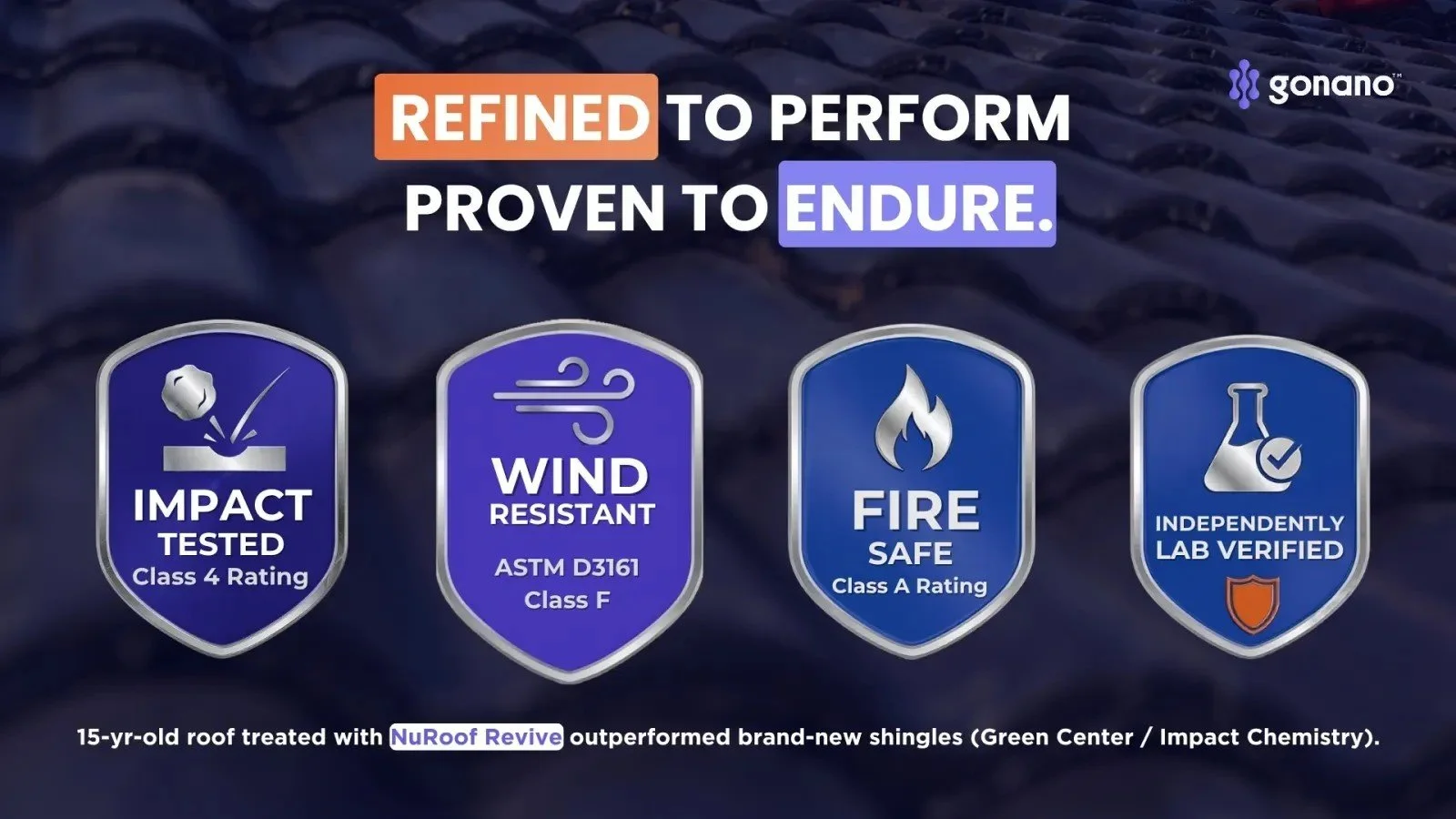
GoNano has invested over $1 million in independent third-party testing. Our nanosilica roof treatments have been independently tested under UL 2218 (achieving Class 4 Impact Resistance the highest classification), ASTM D3161 (achieving Class F wind resistance 110 mph sustained), and UL 790 (achieving Class A fire resistance the highest classification). Testing has been conducted by UL Solutions, Impact Chemistry (Green Center), and CNETE totaling over $1 million in independent verification, with additional IBHS-aligned performance testing ongoing.
What "Patented" Means, and What It Doesn't
A patent protects intellectual property by granting the right to exclusive commercial use of an invention. A patent does not validate product performance. A product can be patented without ever being independently tested for impact, wind, or fire resistance. "Patented" and "independently tested" are different categories of claim and should not be conflated.
Patent protection is a legal designation administered by national patent offices. Its sole function is to prevent competitors from using the patented formulation without authorization. A patent is granted based on novelty (the formulation must not exist in prior art) and non-obviousness (it must not be a trivial variation of existing technology). The patent office does not, at any point in the process, evaluate whether the product actually works as the patent application claims.
This is why "patented" appears so frequently in roof rejuvenation marketing: it is a relatively easy designation to obtain, and it sounds scientifically credible to consumers.
By contrast, a UL 2218 Class 4 classification, an ASTM D3161 Class F classification, or a UL 790 Class A classification is a documented performance result. The laboratory conducted the testing under standardized protocol. The product either met the classification or it did not. The result is verifiable through the testing body, not through the manufacturer.
This distinction matters because it gives homeowners a clear way to evaluate competing claims. "Patented modified triglyceride formula" or "patented polymer emulsion" describes what a product is made of, not what it does under independent testing. "UL 2218 Class 4" describes what a product does under standardized impact testing regardless of what it is made of.